Bakery Kawaii Clipart
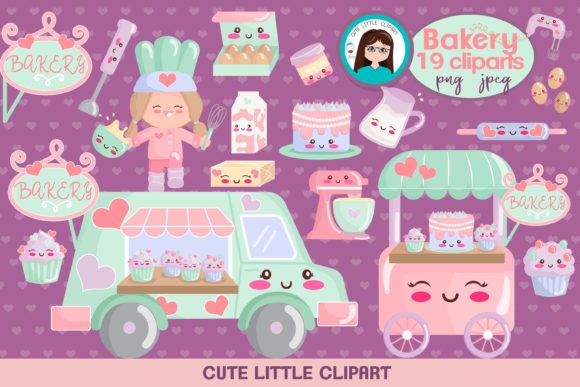
Kawaii—a Japanese aesthetic rooted in cuteness, simplicity, and gentle charm—has long resonated with creators seeking warmth, approachability, and emotional connection in visual communication. When applied to bakery-themed illustration, it transforms everyday baking motifs—cupcakes, croissants, rolling pins, aprons, and smiling pastry chefs—into expressive, friendly, and highly adaptable design assets. Bakery Kawaii Clipart refers specifically to a curated set of 19 high-resolution, commercially licensed illustrations designed for real-world application: 16 x 16 inches at 300 DPI, delivered as PNG files with transparent backgrounds and JPEGs on white. This isn’t decorative filler—it’s functional visual infrastructure.
Where Bakery Kawaii Clipart Fits Into Your Creative Workflow
These illustrations don’t exist in isolation. They slot into stages across multiple workflows—before ideation, during production, and after delivery. For example, a small-batch bakery owner sketching a new loyalty program might use the “planner bakery girl” element early on to visualize customer touchpoints on a whiteboard or Notion dashboard. A freelance graphic designer building a client’s seasonal menu can drop in a cupcake icon with transparent background directly into Adobe Illustrator, scale it without quality loss, and layer it over hand-lettered typography—all before final export.
In education, a primary school teacher preparing a “My Dream Bakery” unit may print the croissant or whisk icons onto cardstock for sorting activities, then later reuse the same assets digitally in a Canva slideshow. The consistency across formats—PNG transparency for layered digital work, JPEG white background for quick print-and-go tasks—means one asset serves dual purposes without reformatting or compromise.
Integration With Tools You Already Use
Compatibility is built in. These cliparts are resolution-agnostic in practice: 300 DPI ensures crisp output whether you’re printing fabric for custom aprons or exporting a 4K social media banner. Because they’re delivered as individual PNGs (not grouped PSDs or vector files), they import cleanly into Canva, Figma, Affinity Designer, Cricut Design Space, Silhouette Studio, and even Microsoft PowerPoint—no conversion needed. If you’re using Procreate, simply drag the PNG into your canvas and adjust opacity or blend mode for subtle texture overlays.
For embroidery digitizers, the clean outlines and consistent line weight across all 19 elements make them ideal base references. Trace the “baking mitt” or “flour sack” motif at 75% scale, simplify anchor points in Inkscape, then export to DST format—no redrawing from scratch. Likewise, sublimation printers benefit from the white-background JPEGs when prepping mugs or tote bags: no clipping mask required, no edge artifacts.
Practical Implementation Tips for Consistent Results
- Organize by use case, not just subject. Create folders like “Print-Ready (White BG)”, “Digital Layers (Transparent)”, and “Scaled-Down (Keyring Size)” rather than “Cupcakes”, “Oven”, etc. This reflects how you’ll actually reach for them mid-project.
- Test contrast and legibility early. Drop a “planner bakery girl” icon onto a light beige mug mockup or navy notebook cover in your design software—then check readability at thumbnail size. Adjust stroke weight or add a subtle drop shadow if needed.
- Preserve transparency integrity. When placing PNGs into layered documents, avoid flattening unless necessary. Keep each clipart on its own layer with blending modes intact—this allows quick recoloring via Hue/Saturation adjustment layers later.
- Batch-resize intelligently. Use Photoshop Actions or Affinity Photo’s Export Persona to generate multiple sizes (e.g., 200px for app icons, 1200px for posters) from one master file. Don’t manually scale up—the original 16 x 16 inch dimension gives ample headroom for downsizing without pixelation.
Real-World Applications Across Roles
A freelance stationery designer uses the “birthday cake with candles” and “baker holding tray” elements to build themed digital card templates in Canva. Clients receive editable links—changing text or colors doesn’t require redesigning the core graphics. Meanwhile, a homeschool parent prints the “cookie jar” and “rolling pin” icons onto sticker paper, cuts them out, and uses them as reward tokens in a weekly chore chart—reinforcing routine through tactile, joyful visuals.
For educators creating printed school materials, the set supports both curriculum-aligned content and classroom culture-building. A science teacher illustrating the states of matter might pair the “melted chocolate bar” icon with a diagram of phase change; an art teacher uses the “pastry bag with swirl” as a reference for line variation exercises. All while staying within commercial license terms—no attribution required, no usage caps.
Small business owners launching merchandise find immediate utility: the “baking soda box” and “apron with pocket” illustrations translate seamlessly to heat-transfer vinyl for kids’ cooking kits, or become repeat patterns for tea towels via Spoonflower integration. Even embroidery studios use the clean silhouettes as stitch guides—scaling down the “whisk” icon to 1.5 inches fits perfectly on a child’s chef hat.
Long-Term Usability and Quality Control
Because these illustrations were created as a unified set—not pieced together from disparate sources—they share consistent stroke weight, rounded corner radius, color palette harmony (soft pinks, creamy beiges, mint greens), and proportional balance. That cohesion matters when assembling multi-element layouts: a poster featuring six different cliparts won’t look like a collage—it reads as intentional design.
To maintain quality control over time, treat the folder as a living resource library. Add a README.txt noting version date and license scope. When updating branding, swap in a single revised icon (e.g., update the “coffee cup” to match new brand colors) rather than replacing the entire set—preserving workflow continuity.
Also consider accessibility: while kawaii aesthetics prioritize charm, ensure sufficient contrast when placing light-colored cliparts on pale backgrounds (e.g., pastel notebooks or cream-colored mugs). A quick luminosity check in your design tool prevents unintended washout in final output.
Getting Started Without Overcomplication
You don’t need to use all 19 elements at once—or even all at once in a single project. Start with three that align with your next deliverable: the “planner bakery girl” for productivity tools, the “cupcake with cherry” for greeting cards, and the “flour sack” for packaging labels. Import them. Test placement. Adjust spacing. Then expand as confidence grows.
What makes Bakery Kawaii Clipart effective isn’t novelty—it’s reliability. It reduces decision fatigue during tight deadlines, eliminates licensing uncertainty, and delivers predictable visual outcomes across physical and digital outputs. Whether you’re prototyping a new product line, supporting student engagement, or building a cohesive brand identity, these illustrations function as quiet enablers—not distractions.
They’re ready when you are: scaled, licensed, and structured for action—not just admiration.