Japanese Geometric Patterns
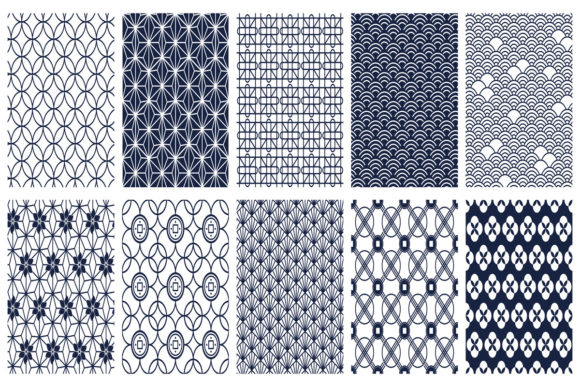
Japanese geometric patterns—like seigaiha (wave), asano-ha (hemp leaf), and shippō (seven treasures)—are centuries-old visual languages rooted in nature, philosophy, and craftsmanship. They’re not just decorative motifs; they’re structured expressions of balance, repetition, and harmony. This collection brings together authentic interpretations of those traditions in a ready-to-use digital format: one EPS10 vector file and a 72ppi JPEG preview.
Why These Patterns Matter—Differently—for Different People
A designer preparing packaging for a matcha tea brand sees seigaiha as rhythm and calm—a way to signal authenticity without literal imagery. A high school art teacher uses the same wave pattern to demonstrate symmetry, tessellation, and cultural context in a lesson on global design systems. A small-batch ceramicist imports the EPS file directly into her laser cutter software to etch repeating motifs onto stoneware glazes. What’s consistent across all these uses is intention—not ornament for its own sake, but geometry with meaning and function.
For Beginners: Clarity Over Complexity
If you’re new to digital design or Japanese aesthetics, this collection lowers the entry barrier. The EPS10 file scales infinitely without pixelation—no need to wrestle with resolution settings or distortion when resizing. The JPEG preview gives immediate visual reference, so you can assess tone and density before opening vector software. You don’t need advanced knowledge of kamon (family crests) or mon-yō (heraldic motifs) to start experimenting. Try layering a subtle shippō background behind hand-lettered calligraphy, or use a single asa-no-ha unit as a watermark on social media posts. It’s learning by doing—no glossary required.
For Design Professionals & Creatives
Professionals prioritize flexibility and fidelity. The EPS10 format ensures clean paths, editable anchor points, and compatibility with Illustrator, Affinity Designer, CorelDRAW, and most professional print workflows. Unlike raster-only packs, this lets you recolor individual segments, adjust spacing between units, or isolate elements for animation or embroidery digitizing. One graphic designer used the seigaiha pattern to build a responsive SVG background for a wellness app—scaling fluidly from mobile to desktop while preserving crisp edges. Another adapted the shippō motif into a modular tile system for custom wallpaper, adjusting repeat dimensions to fit client wall measurements precisely.
Educators & Curriculum Developers
In classrooms or workshops, these patterns support cross-disciplinary learning. Math teachers explore rotational symmetry and tiling theory using the shippō hexagonal grid. History educators connect motifs to Edo-period textile production or Zen garden layouts. Art instructors guide students through tracing, mirroring, and recombining units—building both technical skill and cultural literacy. Because the JPEG preview is low-res by design, it’s ideal for slide decks or handouts where clarity matters more than print fidelity. And since the EPS file is editable, students can deconstruct and reconstruct patterns themselves—turning passive viewing into active making.
Small Business Owners & Makers
Time and consistency are non-negotiable for entrepreneurs launching products or branding. With this collection, a soap maker can apply the same wave motif across labels, website headers, and Instagram story templates—ensuring visual cohesion without hiring a designer for every asset. A stationery brand embedded the asa-no-ha pattern into foil-stamped business cards, then reused the vector path for laser-cut wooden gift tags. No licensing surprises: the files are for commercial use, including physical goods and digital distribution. That reliability means fewer delays, fewer revisions, and stronger brand recognition over time.
Hobbyists & Home Decor Enthusiasts
You don’t need a Cricut or a printing press to enjoy these patterns. Print the JPEG at home for scrapbooking, decoupage, or stenciling. Import the EPS into free tools like Inkscape to generate cut files for paper quilling or vinyl decals. One user resized a single shippō unit to fit a 4x4 inch embroidery hoop, then stitched it by hand using traditional sashiko thread. Another projected the JPEG onto a blank wall, traced it lightly in pencil, and painted a minimalist wave frieze in matte indigo—no digital tools involved. The value isn’t in complexity—it’s in accessibility and quiet satisfaction.
What to Consider Before You Use Them
Ask yourself: what’s your primary goal? If speed matters most—say, finishing a client presentation tomorrow—the JPEG preview may be all you need. If long-term reuse is key—like building a brand identity system or teaching a semester-long course—the EPS file unlocks adaptability that raster images can’t match. Quality here isn’t about “high-resolution” in the marketing sense; it’s about structural integrity. An EPS built with clean vectors holds up across mediums—from tiny app icons to 8-foot trade show banners—without compromise.
Flexibility also means knowing when *not* to overuse. Japanese geometric patterns thrive in restraint. A full-bleed seigaiha background works powerfully behind minimal typography—but layered with three other motifs, it risks visual noise. Consider scale, contrast, and negative space as part of the pattern itself. That’s where the preview JPEG helps: it shows density and rhythm at a glance, letting you gauge whether a motif supports or competes with your message.
Real-World Fit: Does This Match Your Needs?
- You’re designing for print or product: Yes—the EPS file delivers production-ready vectors.
- You teach design, math, or cultural studies: Yes—the modularity and historical grounding support hands-on learning.
- You work with limited software or budget: Yes—the JPEG preview is universally viewable; the EPS opens in free and paid vector editors alike.
- You need photorealistic textures or hand-painted effects: No—these are clean, intentional geometries, not brushwork or grain.
- You require hundreds of variations or animated versions: No—this is a focused set, not an expansive library.
Japanese geometric patterns aren’t trends. They’re tools—quiet, precise, and deeply considered. Whether you’re sketching a logo concept, prepping a classroom demo, or choosing fabric for a cushion cover, their strength lies in how thoughtfully they’re applied—not how many you own. This collection offers that foundation: one vector source, one clear preview, and the space to make it meaningfully yours.