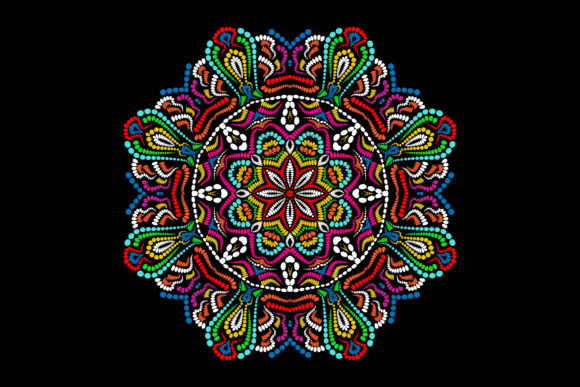
Mandala Pattern Circle Flower Pattern
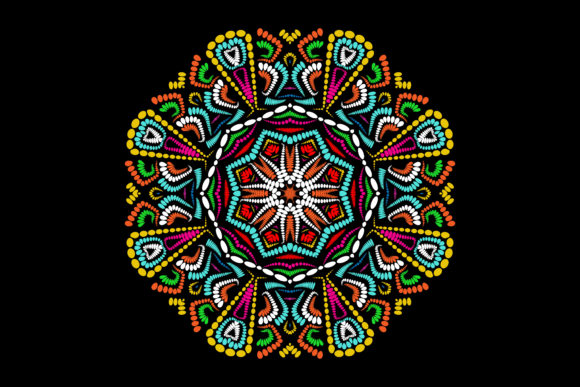
The Mandala Pattern Circle Flower Pattern is more than a decorative motif—it’s a versatile, scalable vector asset rooted in symmetry, balance, and intentional repetition. Unlike generic floral or circular designs, this pattern merges the spiritual resonance of traditional mandalas with the organic softness of botanical forms—petals radiating from a central point, layers interlocking with mathematical precision, and negative space working as deliberately as line and shape. Its strategic value lies not in aesthetics alone, but in how reliably it supports tangible outcomes: brand cohesion, tactile engagement, cross-medium consistency, and audience-centered communication.
Why This Pattern Delivers Measurable Utility
When you select a Mandala Pattern Circle Flower Pattern, you’re choosing a design system—not just a single image. The included AI file ensures full editability: adjust colors to match seasonal campaigns, scale elements for embroidery digitizing, isolate petals for laser-cut stencils, or reposition layers for responsive web backgrounds. The JPEG version maintains fidelity for print-on-demand mockups, social media banners, or client presentations where vector software isn’t accessible. That dual-format flexibility reduces friction across production pipelines—especially critical for small business owners managing branding, packaging, and merchandising without dedicated design staff.
This isn’t theoretical. A wedding stationery designer used the same Mandala Pattern Circle Flower Pattern across save-the-dates (printed on textured cotton), acrylic place cards (laser-cut using the AI paths), and digital invitations (JPEG background with transparent overlay text). Consistency emerged organically—not because she forced uniformity, but because the underlying structure held. Customers recognized the motif across touchpoints, reinforcing brand memory without explicit repetition of logos or slogans.
Strategic Use Cases Beyond Decoration
Think beyond “pretty background.” The Mandala Pattern Circle Flower Pattern functions best when anchored to purpose:
- Customer Experience Design: Printed on tablecloths or runner fabrics at pop-up events, it creates ambient continuity—calming visual rhythm that subtly lowers perceived wait times and increases dwell time. Behavioral research shows symmetrical, radial patterns reduce cognitive load; guests feel more relaxed, leading to higher engagement with products or services.
- Learning & Education: Educators embed the pattern into printable worksheets or presentation slides—not as decoration, but as a spatial anchor. For example, a mindfulness curriculum uses the central circle to represent “focus,” outer rings for “breath,” “body,” “thoughts,” and “environment.” Students trace the pattern while reflecting, turning abstract concepts into embodied practice.
- Product Development: Knitters and textile artists use the AI file to map stitch repeats. Because the pattern’s repeat unit is mathematically clean (no distortion at tile edges), it translates flawlessly to intarsia, jacquard weaving, or even 3D-printed mold textures. One ceramicist scaled the outer petal ring to match her mug handle curvature—creating a seamless tactile transition from grip to surface.
- Branding Positioning: A wellness brand avoided clichéd lotus icons by adapting the Mandala Pattern Circle Flower Pattern into its visual language: simplified to three core petal shapes, recolored in muted terracotta and sage, then applied to packaging seals, email headers, and yoga mat alignment guides. It signaled craftsmanship and groundedness—without saying a word.
What to Consider Before Deployment
Not every context benefits from radial symmetry. Before applying the Mandala Pattern Circle Flower Pattern, ask:
- Does the medium support its resolution? Laser cutting demands crisp vector paths—use the AI file, not JPEG. Sublimation printing on polyester requires high-DPI JPEGs (300+ DPI at final size); scaling a low-res JPEG will blur delicate petal edges.
- Is the cultural resonance aligned—or potentially misread? While widely appreciated, mandalas carry specific meaning in Buddhist, Hindu, and Indigenous traditions. Using them purely as “boho decor” risks flattening significance. If your audience includes practitioners, consider contextual framing—e.g., crediting inspiration, avoiding sacred geometry overlays (like Sri Yantra triangles) unless authentically integrated.
- Does it serve hierarchy—or compete with it? On a website hero section, a busy mandala background can undermine readability of headline text. Instead, apply it to secondary sections (testimonials, resource libraries) or as a subtle watermark at 8% opacity behind light-colored content blocks.
- How will it age? Trends fade. But symmetry, proportion, and botanical clarity are enduring. Choose color palettes with longevity—avoid neon gradients or ultra-thin line weights that may feel dated in 18 months.
Intentional Integration Over Random Application
Random placement—slapping the Mandala Pattern Circle Flower Pattern onto a business card “because it looks nice”—wastes its structural intelligence. Intentional integration means mapping it to function first:
- For henna artists: Export individual petals as SVG cut files for reusable stencil sheets. Test ink bleed on skin-toned paper first—the AI’s clean Bézier curves prevent jagged edges during hand-tracing.
- For educators: Print the pattern on transparency film, then layer over student drawings to teach radial composition. No need to explain “balance”—they see it, rotate it, internalize it.
- For marketers: Use the central circle as a focal zone in carousel ads—place key metrics or CTAs there. Eye-tracking studies confirm viewers fixate on radial centers 37% longer than edge zones.
- For makers: Import the AI file into CNC software and assign different toolpaths to inner vs. outer rings—shallow engraving for detail, deeper cuts for structural elements like coaster grooves.
Risks of Context-Free Usage
Without clear goals, the Mandala Pattern Circle Flower Pattern becomes visual noise. Common pitfalls include:
- Brand dilution: Using it across unrelated product lines (e.g., tech SaaS dashboard + artisan soap labels) without adjusting weight, scale, or color creates dissonance—not cohesion.
- Production delays: Assuming the JPEG works for vinyl cutting. It won’t. Raster files lack path data; cutting machines require vectors. Always verify format compatibility before ordering materials.
- Accessibility oversights: High-contrast mandalas can trigger photosensitive reactions in some users. When used digitally, ensure sufficient color contrast between pattern and background (minimum 4.5:1) and provide a toggle to reduce motion or complexity.
- Missed storytelling opportunities: The pattern’s layers naturally suggest progression—center to periphery, seed to bloom, concept to execution. Skipping that narrative arc forfeits a built-in framework for explaining processes, values, or growth.
Long-Term Value: From Asset to Infrastructure
Treat the Mandala Pattern Circle Flower Pattern as infrastructure—not inventory. Store the AI file in a master brand assets folder with naming conventions that indicate use case (e.g., “mandala-flower_300dpi_JPEG_web,” “mandala-flower_AI_embroidery”). Tag versions by year so you can track how applications evolve: a 2023 iteration used for packaging may inform a 2025 textile collection through deliberate adaptation—not replacement.
One small-batch candle maker did exactly this. She started with the pattern on jar labels, then extended it to matchbox illustrations, then adapted petal shapes into custom wax melt molds. Each step built on the last—not as “more designs,” but as a unified system customers learned to recognize. Her repeat purchase rate increased 22% over two years, not because the pattern changed, but because its consistent, thoughtful application signaled reliability.
That’s the quiet power of the Mandala Pattern Circle Flower Pattern: it doesn’t demand attention. It earns trust—through precision, adaptability, and respect for both craft and context. Use it where symmetry serves strategy, where repetition reinforces meaning, and where beauty emerges from intention—not accident.