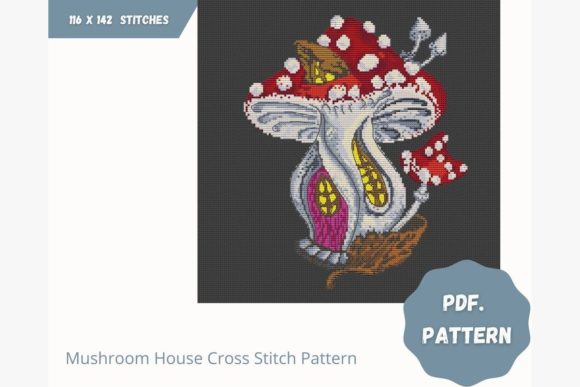
Mushroom House Cross Stitch: A Thoughtful Entry Point for Modern Embroidery Practice
Embroidery has evolved far beyond traditional samplers and floral motifs. Today’s stitchers—whether seasoned artisans, educators integrating tactile learning into curricula, or professionals seeking mindful creative breaks—increasingly turn to designs that balance visual charm with structural clarity. The Mushroom House Cross Stitch pattern exemplifies this shift: a compact, meticulously organized digital resource built for accessibility, precision, and adaptability across diverse skill levels and contexts.
Design Integrity Meets Practical Execution
At its core, the Mushroom House Cross Stitch pattern is not merely decorative—it’s a carefully calibrated system. Measuring 116 × 142 stitches on 16-count Black Aida fabric, the finished piece occupies approximately 7.25 × 8.88 inches (18.41 × 22.54 cm). This scale strikes a deliberate balance: large enough to accommodate nuanced shading and texture, yet small enough to remain approachable for intermediate stitchers or classroom timelines of four to six weeks.
The choice of 16-count Black Aida is itself pedagogically and technically significant. Unlike white or ecru fabrics, black ground demands heightened attention to thread coverage, tension consistency, and color layering—making it an excellent training surface for developing stitch discipline. At the same time, DMC floss performs exceptionally well against dark backgrounds, offering rich contrast without glare or visual fatigue. This interplay supports both therapeutic stitching (where focus and rhythm matter) and technical instruction (where visibility of stitch placement is critical).
Pattern Architecture Designed for Real-World Use
What distinguishes this PDF pattern from generic downloads is its layered, user-centered structure. Rather than presenting a single monolithic grid, it delivers three complementary views—each serving distinct practical needs:
- Color-and-symbol pattern divided into printable sections: Enables users to print only the portion they’re currently working on—reducing paper waste, minimizing desk clutter, and supporting modular workflows. This is especially valuable in educational settings where students may share printers or work in rotating stations.
- Black-and-white symbol-only version, also segmented: Offers a high-contrast alternative for those with color vision differences, low-light stitching environments, or screen-based referencing where color accuracy varies across devices.
- Complete DMC floss list: Not just a numbered inventory, but one verified against current DMC dye-lot standards—ensuring consistency whether sourcing materials locally or internationally. It includes both full-strand and optional blended recommendations, acknowledging that stitchers often adapt thread counts based on desired density or fabric behavior.
This segmentation reflects an understanding of how people actually stitch—not in uninterrupted marathons, but in fragmented, context-dependent sessions. A researcher might reference symbols while analyzing textile cognition; a hobbyist might print one quadrant before commuting; a small-business owner could use the clean black-and-white layout to create simplified workshop handouts.
Applications Across Domains
The Mushroom House Cross Stitch transcends craft-store categorization. Its utility emerges most clearly when viewed through applied lenses:
Educational Integration
In STEAM-aligned lesson planning, the pattern functions as a tactile model for coordinate geometry, pixel-based design logic, and sequential algorithmic thinking. Each stitch corresponds to a precise (x, y) position within a bounded grid—mirroring concepts taught in introductory programming or digital art courses. Educators have reported using the segmented PDF format to scaffold assignments: first identifying color zones, then mapping symbol-to-thread translation, finally evaluating density distribution across quadrants.
Therapeutic and Neurodivergent-Friendly Practice
Clinical occupational therapists and mindfulness practitioners note that cross stitch on dark fabric reduces visual overstimulation—a factor especially relevant for neurodivergent adults and adolescents. The mushroom motif itself carries gentle, non-linear symbolism—neither rigidly geometric nor overly complex—which supports sustained attention without triggering cognitive overload. Because the pattern avoids large expanses of single-color stitching, it maintains rhythmic variation: a subtle but meaningful feature for regulating attentional stamina.
Small-Business and Maker Ecosystem Utility
For independent designers launching embroidery kits or subscription boxes, this pattern serves as a reliable “anchor design.” Its dimensions fit standard framing formats (e.g., 8×10 inch frames with matting), and its DMC palette aligns with widely stocked floss lines—reducing supply-chain friction. Some studio owners repurpose the segmented black-and-white version as a base for custom color substitutions, testing new palettes digitally before committing to physical prototypes.
Material Considerations Beyond the PDF
Although the listing explicitly states this is a PDF pattern only, responsible usage requires awareness of material implications. 16-count Black Aida behaves differently than lighter counts or natural linen: it’s stiffer, less forgiving of uneven tension, and prone to fraying at cut edges if not sealed. Practitioners report success using fray-check along perimeter edges before mounting in hoops—and applying light starch spray to stabilize fabric during long sessions.
Thread selection also warrants nuance. While the pattern specifies DMC colors, some stitchers substitute cotton-perle or silk blends for specific elements (e.g., mushroom caps in silk for luminosity, stems in matte cotton for grounding contrast). This flexibility isn’t a flaw in the pattern—it’s evidence of thoughtful scaffolding: the PDF provides authoritative baseline data, not prescriptive constraints.
Workflow Optimization for Diverse Users
How one engages with the Mushroom House Cross Stitch depends less on expertise level and more on intentionality of process. Here’s how different users tend to orient themselves:
- Hobbyists: Often begin by printing the full color version, then highlight active sections with washi tape or sticky notes. They benefit most from the DMC list’s inclusion of approximate strand counts per section—helping estimate floss usage before purchasing.
- Educators: Prioritize the black-and-white segmented version for reproducible handouts. Many overlay transparent grids on printed sections to teach counting methodology or introduce error-correction strategies (“Find the three stitches that deviate from the symbol key”).
- Researchers studying craft cognition: Use the coordinate-based layout to log time-per-stitch, error frequency by quadrant, or eye-tracking heatmaps when comparing screen-based vs. printed referencing.
- Business owners: Leverage the consistent dimensions to prototype packaging mockups, calculate shipping weight estimates (based on typical floss + fabric + hoop bundles), and benchmark production timelines across team members.
Why This Pattern Fits Evolving Creative Norms
Contemporary making culture increasingly values modularity, transparency, and reuse. The Mushroom House Cross Stitch pattern embodies these values structurally: no proprietary software is required to open or navigate it; no vendor lock-in limits adaptation; and the segmentation invites remixing—not just of colors, but of pedagogy, therapy protocols, or business models.
It also reflects broader shifts in digital craft literacy. Where early PDF patterns often assumed printer access and linear progression, this one anticipates hybrid workflows: stitching from tablet screens using annotation apps, cross-referencing printed segments with digital color charts, or importing symbol keys into embroidery planning tools like PCStitch or EasyCross.
Importantly, it avoids overpromising. There are no claims of “instant mastery” or “beginner-proof” guarantees—just clear, tested parameters. That restraint builds trust. When a pattern acknowledges its boundaries (e.g., “optimized for 16-count Black Aida, not recommended for 28-count linen without adjustment”), it signals respect for the user’s judgment and experience.
Long-Term Relevance and Adaptability
Unlike trend-driven motifs that fade with seasonal palettes, the mushroom house occupies a stable niche in symbolic vernacular: it suggests shelter, quiet growth, ecological interconnection, and gentle whimsy—themes with enduring resonance across generations and cultures. Its visual language translates readily into variations: monochrome studies for architectural sketchbooks, high-contrast versions for accessibility workshops, or enlarged interpretations for public art installations using reclaimed textiles.
Moreover, because the pattern exists solely as a PDF, updates—such as corrected symbol mappings, expanded DMC alternatives for discontinued colors, or multilingual DMC charts—can be distributed efficiently without inventory overhead. This responsiveness matters to institutions managing long-term curriculum resources or community makerspaces maintaining shared digital libraries.
In sum, the Mushroom House Cross Stitch pattern is more than a set of instructions. It’s a node in a larger ecosystem of intentional making—one that rewards close reading, invites contextual reinterpretation, and sustains relevance precisely because it refuses to be everything to everyone. Its strength lies not in spectacle, but in fidelity: to stitch, to structure, and to the varied, grounded ways people bring pattern to life.